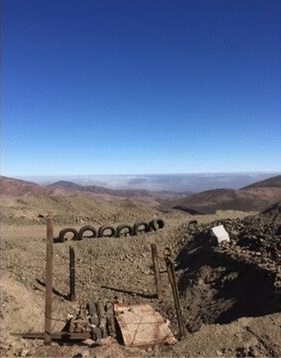
In this article, we ask how traces of political violence in the Atacama Desert and in the Sonoran Desert are created and how they are (or are not) transformed into archives. The political violence we study is of different types and takes place in different periods: state violence under the civil–military dictatorship (1973-1990) in the Atacama; violence as a product of migratory policies (from 1994 to the present) of the US–Mexican border in the Sonoran Desert in Arizona; and, mass death and disappearance as the product of successive governments’ “war on drugs” (from 2006 to the present) in Sonora, Mexico. This article is based on our academic ethnographic work and volunteering with grassroots organizations. In these three arid spaces, we met different groups: family members and activists searching for political prisoners disappeared in the 1970s by the Pinochet regime; activists searching for migrants, dead or alive, lost in the Sonoran Desert in Arizona; and families digging in the earth, unearthing clandestine graves and hoping one day to find the remains of their loved ones. We argue that these different search practices create traces when these groups uncover what the perpetrators wanted to hide. These processes that create traces, then create archives when the situated and lived experience of searching and tracing is translated into artifacts that can be detached from their context and acquire multiple uses outside their place of production.
Scouring the desert: political violence traceability in the Americas
Ver más publicaciones
Ver o descargar
Resumen / Abstract:
Título:
Scouring the desert: political violence traceability in the Americas
Autor/as:
Año de publicación:
2024
Revista / Libro / Editorial:
Arch Sci 24, 307–327
DOI / ISBN / Identificador:
DOI:10.1007/s10502-023-09432-8
Proyecto(s) relacionado(s):
Otra información: